Carving Out Success: Persistence as Your Secret Weapon in STEM and VEX Robotics


“A drop of water hollows a stone, not by force, but by falling often.” This ancient proverb, often attributed to Ovid, speaks volumes about the power of persistence. It’s a message that resonates deeply within the world of STEM and, more specifically, VEX Robotics. While the world of robots might seem a far cry from the patient dripping of water, the truth is they share a fundamental principle: consistent effort leads to incredible results.
Think about it. Building a robot isn’t about brute strength or sudden bursts of energy. It’s about carefully planned steps, meticulous testing, and the willingness to try again and again, even when things go wrong (and they will!). Just like that persistent drop of water, it’s the constant, focused effort that eventually carves out success.
Why is Persistence So Important in STEM?
STEM fields – science, technology, engineering, and mathematics – are inherently challenging. They demand critical thinking, problem-solving skills, and a willingness to grapple with complex concepts. It’s easy to get discouraged when faced with a difficult equation, a buggy code, or a robot that just won’t cooperate. This is where persistence comes in.
Think of persistence as your secret weapon, your superpower in the world of STEM. It’s the quality that allows you to:
- Overcome obstacles: Every STEM project will throw challenges your way. A persistent student sees these obstacles not as roadblocks, but as opportunities to learn and grow.
- Develop resilience: Failure is an inevitable part of the learning process in STEM. Persistence helps you bounce back from setbacks, learn from your mistakes, and keep moving forward.
- Achieve mastery: Whether you’re mastering a coding language, designing a complex mechanism, or troubleshooting a robot, persistence is the key to achieving a deep understanding and proficiency.
Persistence in Action: The VEX Robotics Arena
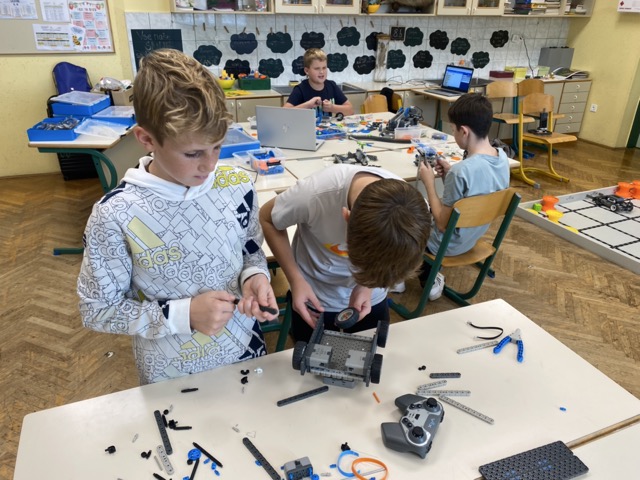
VEX Robotics competitions provide a perfect example of how persistence pays off. Imagine the scene: teams of students huddled around their robots, tweaking designs, testing code, and strategizing for the next match. The energy is electric, a mix of excitement and nervous anticipation.
Now, let’s zoom in on one team. Their robot isn’t performing as expected. Maybe it’s struggling to pick up game objects, or its autonomous program is going haywire. Disappointment is evident, but they don’t give up. They analyze the problem, brainstorm solutions, and get to work. They try different approaches, test and retest, and gradually, they start to see improvement.
This is persistence in action. It’s the driving force that pushes teams to refine their designs, optimize their code, and ultimately, achieve their goals. And the rewards go beyond just winning a competition. Through this process, students develop valuable skills that will serve them well in any field they choose to pursue.
How to Cultivate Persistence
Persistence isn’t necessarily an innate trait; it’s something you can develop and strengthen over time. Here are a few tips for students and educators:
For Students:
- Embrace challenges: Don’t shy away from difficult problems. See them as opportunities to stretch your abilities and learn something new.
- Break down tasks: Large projects can seem overwhelming. Break them down into smaller, more manageable steps.
- Celebrate small victories: Acknowledge and celebrate your progress, no matter how small it may seem.
- Learn from mistakes: Don’t be afraid to make mistakes. Analyze what went wrong, learn from it, and try again.
- Find a mentor: Connect with someone who inspires you and can offer guidance and support.
- Don’t compare yourself to others: Focus on your own progress and celebrate your unique strengths.
For Educators:
- Create a supportive learning environment: Foster a classroom culture where students feel comfortable taking risks and learning from their mistakes.
- Encourage collaboration: Provide opportunities for students to work together and learn from each other.
- Provide constructive feedback: Offer specific and actionable feedback that helps students identify areas for improvement.
- Celebrate effort and progress: Recognize and reward students for their hard work and dedication, not just their achievements.
- Connect learning to real-world applications: Help students see how the concepts they’re learning apply to real-world situations.
- Be a role model: Demonstrate persistence in your own work and approach to challenges.
The Ripple Effect of Persistence
The impact of persistence extends far beyond the classroom or the robotics arena. It ripples out into all areas of life. Students who learn to persevere in the face of challenges are better equipped to succeed in their future careers, pursue their passions, and make a positive impact on the world.
Just like that drop of water gradually shaping the stone, the consistent effort you put into your STEM education will shape your future. It will open doors to new opportunities, empower you to solve complex problems, and enable you to contribute to the advancement of science and technology.
So, the next time you’re faced with a challenging coding problem, a frustrating robot malfunction, or a seemingly impossible task, remember the power of persistence. Keep that drop of water falling, and you’ll be amazed at what you can achieve.