“Knowledge is of No Value Unless You Put it Into Practice”: A STEM and VEX Robotics Perspective

Introduction
In today’s rapidly evolving world, knowledge alone is no longer sufficient. The true value of knowledge is realized when it is applied in meaningful ways. As the saying goes, “Knowledge is of no value unless you put it into practice.” This is especially true in the context of STEM (Science, Technology, Engineering, and Mathematics) education and robotics, particularly VEX Robotics. Both fields emphasize hands-on learning, problem-solving, and innovation—key elements that transform theoretical knowledge into practical skills.
STEM and VEX Robotics go beyond traditional classroom learning by encouraging students to engage in real-world challenges that foster creativity, collaboration, and critical thinking. This article explores the importance of applying knowledge in STEM and VEX Robotics, how these fields help students move from theory to practice, and why hands-on learning is critical for success in these disciplines.
The Importance of Applying Knowledge
In many educational settings, students are often bombarded with theoretical knowledge—formulas, laws, and principles—but fail to understand how to apply them in practical scenarios. While foundational knowledge is crucial, it’s the application of that knowledge in solving real-world problems that makes it valuable. In STEM, this becomes even more pertinent as technology evolves at a rapid pace, and the ability to adapt and apply knowledge becomes a competitive advantage.
Moving Beyond Memorization
STEM education has historically suffered from a focus on rote memorization. For decades, students have been encouraged to memorize formulas, theorems, and scientific laws to pass exams, often with little understanding of how these concepts apply in real-world contexts. This disconnect can lead to a lack of engagement and a sense of irrelevance when students don’t see how their academic knowledge translates into tangible outcomes.
By shifting the focus from memorization to application, STEM education becomes more engaging and meaningful. Students learn that knowledge is not static but dynamic, and its true value is unlocked when they can apply what they’ve learned to real-world problems. This shift encourages deeper learning, fosters curiosity, and inspires innovation.
Critical Thinking and Problem-Solving
In STEM fields, critical thinking and problem-solving are essential skills. Simply knowing a formula or a scientific principle is not enough. Students must learn how to analyze complex situations, identify problems, and come up with innovative solutions. This is where the application of knowledge comes into play.
For example, understanding the principles of physics is essential, but applying them to build a functional robot in VEX Robotics competitions requires critical thinking and creativity. Students must think about how to optimize their robot’s design, improve its functionality, and troubleshoot issues in real time. This hands-on experience teaches them that knowledge is not just something to be stored in textbooks but a tool to be used in practical problem-solving.
VEX Robotics: Bridging Theory and Practice
VEX Robotics offers a unique platform where STEM knowledge is put into practice. Through robotics competitions and hands-on projects, students are encouraged to apply their theoretical understanding of science, mathematics, engineering, and technology in real-world scenarios. VEX Robotics challenges students to design, build, and program robots to complete specific tasks, pushing them to think critically and innovatively.
Hands-On Learning
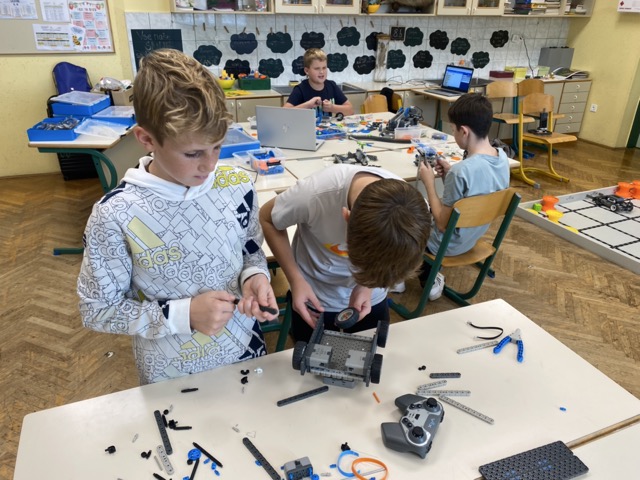
One of the key principles of VEX Robotics is hands-on learning. The best way to learn how something works is by doing it. Whether it’s building a robot, programming it to perform tasks, or troubleshooting design flaws, students gain a deep understanding of STEM concepts by applying them in practice.
For example, students may learn the theoretical principles of torque, force, and velocity in a physics class, but in VEX Robotics, they must apply these concepts when designing a robot’s drive system. They need to factor in the robot’s weight, the number of motors, and how to balance speed with the reduction of torque. This hands-on experience not only reinforces their grasp of abstract concepts but also teaches them how to translate their theoretical knowledge into practical, real-world applications.
Trial and Error
In VEX Robotics, trial and error is an integral part of the learning process. Students are encouraged to experiment with different designs, test them, and make improvements. This iterative process mirrors the way real-world engineering works, where the first solution is rarely the best one. Students quickly learn that failure is not the end but an opportunity to refine their approach and come up with a better solution.
This hands-on, experimental approach also helps students develop resilience and perseverance. In a typical classroom setting, failure is often seen as a negative outcome, but in VEX Robotics, it’s part of the process. Students learn that it’s okay to fail as long as they learn from their mistakes and use that knowledge to improve their designs. This mindset is invaluable not only in STEM fields but in life.
Collaboration and Teamwork
Another important aspect of VEX Robotics is collaboration. While individual knowledge is valuable, complex problems often require teamwork. In VEX Robotics competitions, students work in teams to design, build, and program their robots. Each team member brings their unique skills and knowledge to the table, and they must work together to achieve their goal.
This collaborative approach teaches students that knowledge is most valuable when shared and applied in a team setting. No single person can know everything, but by working together, students can pool their knowledge and expertise to come up with innovative solutions. This mirrors the way real-world engineering teams operate, where collaboration is key to success.
The Role of Inquiry and Exploration in STEM Learning
STEM education emphasizes inquiry-based learning, where students are encouraged to ask questions, explore possibilities, and seek answers through experimentation. This approach contrasts with traditional learning, where students are often passive recipients of information. In STEM, students are active participants in the learning process, using their knowledge to explore new ideas and solve problems.
Encouraging Curiosity
Curiosity is the driving force behind inquiry-based learning. In VEX Robotics, students are constantly asking questions: How can we make the robot faster? How can we improve its accuracy? What can we do to make it more reliable? These questions push students to explore new ideas, test different approaches, and apply their knowledge in novel ways.
This process of exploration helps students develop a deeper understanding of STEM concepts. Instead of simply memorizing formulas or principles, they see how these concepts work in practice. This hands-on, exploratory approach fosters a love of learning and encourages students to become lifelong learners.
Real-World Problem-Solving
STEM education and VEX Robotics provide students with opportunities to solve real-world problems. Whether it’s designing a robot to navigate an obstacle course or developing a solution to a global challenge like climate change, students are encouraged to apply their knowledge to solve complex, real-world issues.
For example, in a VEX Robotics competition, students might be tasked with designing a robot that can move objects from one location to another. This seemingly simple task requires students to apply their knowledge of physics, engineering, and programming to come up with a solution. They must consider factors like weight distribution, motor power, and programming algorithms to achieve their goal.
This type of real-world problem-solving helps students develop critical thinking skills and teaches them how to apply their knowledge in practical situations. It also helps them see the relevance of what they’re learning in the classroom and how it can be used to make a difference in the real world.
STEM Careers: The Value of Applied Knowledge
In the modern workforce, STEM skills are in high demand. However, employers are not just looking for candidates who have theoretical knowledge. They want individuals who can apply that knowledge to solve problems, innovate, and drive progress.
The Importance of Practical Experience
Employers in STEM fields place a high value on practical experience. Whether it’s engineering, computer science, or robotics, having hands-on experience is essential for success. In many cases, students who have participated in VEX Robotics or other STEM competitions have a competitive edge because they have demonstrated their ability to apply their knowledge in real-world situations.
For example, a student who has experience building and programming robots in VEX Robotics will have a deeper understanding of engineering principles and problem-solving techniques than someone who has only learned these concepts in a classroom setting. This practical experience makes them more attractive to employers and better prepared for the challenges of the workforce.
Innovation and Creativity
In today’s rapidly evolving world, innovation is key to success. Employers in STEM fields are looking for individuals who can think creatively and come up with innovative solutions to complex problems. VEX Robotics encourages students to think outside the box and apply their knowledge in creative ways.
For example, in a VEX Robotics competition, students might encounter a challenge that requires them to design a robot that can perform a task in an unconventional way. This requires creative thinking and the ability to apply knowledge in new and innovative ways. This type of experience prepares students for careers in STEM fields, where innovation is often the key to success.
Building a Future Through STEM and Robotics
STEM education and VEX Robotics are not just about teaching students theoretical knowledge. They are about preparing students for the future by giving them the tools they need to apply their knowledge in practical, real-world situations. By encouraging hands-on learning, problem-solving, and collaboration, these fields help students develop the skills they need to succeed in the modern workforce.
The Role of Educators
Educators play a crucial role in helping students bridge the gap between theoretical knowledge and practical application. In STEM education, teachers must encourage students to ask questions, explore new ideas, and apply their knowledge in meaningful ways. This requires a shift away from traditional teaching methods and towards a more inquiry-based, hands-on approach.
In VEX Robotics, teachers and mentors guide students through the process of designing, building, and programming robots. They encourage students to experiment, make mistakes, and learn from their failures. By providing students with opportunities to apply their knowledge in real-world situations, educators help them develop the skills they need to succeed in STEM fields.
Inspiring the Next Generation of Innovators
STEM education and VEX Robotics have the potential to inspire the next generation of innovators. By encouraging students to apply their knowledge in practical ways, these fields help students see the relevance of what they’re learning and how it can be used to make a difference in the world. This hands-on, inquiry-based approach fosters a love of learning and inspires students to pursue careers in STEM fields.
In a world where technology is constantly evolving, the ability to apply knowledge in meaningful ways is more important than ever. STEM education and VEX Robotics provide students with the tools they need to succeed in a rapidly changing world, and they prepare them to be the innovators and problem-solvers of tomorrow.
Conclusion
The phrase “knowledge is of no value unless you put it into practice” is especially true in the context of STEM education and VEX Robotics. While theoretical knowledge is important, its true value is realized when it is applied to solve real-world problems, innovate, and drive progress. Through hands-on learning, collaboration, and critical thinking, students in STEM and VEX Robotics learn how to apply their knowledge in practical ways, preparing them for success in the modern workforce.
As educators and mentors, it is essential to provide students with opportunities to apply their knowledge in meaningful ways, encouraging them to explore, experiment, and innovate. By doing so, we can inspire the next generation of STEM professionals and equip them with the skills they need to make a difference in the world.