Unlocking Curiosity: 5 Questions to Engage Young Learners in STEM through VEX Robotics

Asking children about their day often leads to the predictable response of “fine” or “good.” It’s a conversation stopper, especially when educators and parents want to dig deeper to understand the experiences of their children. However, a shift in approach can open up dynamic conversations, especially when those questions are framed around engaging, hands-on learning activities such as VEX Robotics. STEM (Science, Technology, Engineering, and Mathematics) learning is not only about mastering content but also about nurturing curiosity, problem-solving, and innovation.
Let’s explore five simple yet thought-provoking questions that parents or educators can ask instead of the routine “How was school?” These questions are designed to spark deeper reflection and more meaningful conversations. By extending these inquiries beyond traditional school settings and into the dynamic world of STEM and VEX Robotics, we can engage students in more profound ways. In this blog post, we’ll dive into how these questions can be used to strengthen students’ engagement with STEM learning and robotics activities, fostering connections between their learning and real-world applications.
1. “What made you smile today?”
This question aims to encourage students to reflect on positive moments, creating a sense of joy around their learning experience. When applied to VEX Robotics and STEM learning, this can spark discussions about their personal victories, whether they succeeded in a challenge or discovered something new.
Connecting with STEM: STEM learning, particularly in robotics, offers countless moments of discovery. In VEX Robotics, children learn by doing, which can involve coding their robot to perform tasks, problem-solving a mechanical issue, or simply watching their creation come to life. For example, a student might say, “I was so happy when my robot finally picked up the block after trying so many times!” This creates an opportunity for educators or parents to dive deeper into the learning experience by asking follow-up questions like, “What did you change to make it work?” This promotes reflective thinking, as well as resilience in overcoming challenges—a critical skill in STEM.
Smiling through Robotics Challenges: During robotics competitions or class activities, students experience different emotions. The excitement of their robot completing a task successfully or the teamwork required to solve a problem together can be fulfilling. These moments create a positive association with learning, especially in areas that might otherwise seem intimidating, like coding or engineering.
Encouraging students to recognize and articulate what made them smile in their learning journey also fosters a growth mindset. When they see STEM activities as a space for creativity and fun, they are more likely to engage and persist in the face of challenges.
2. “Who did you sit with at lunch?”
This question often leads to discussions about social dynamics, but in the context of STEM and robotics, it can highlight the importance of teamwork and collaboration. VEX Robotics competitions and classroom projects are rarely individual endeavors; they thrive on group efforts, shared problem-solving, and collective innovation.
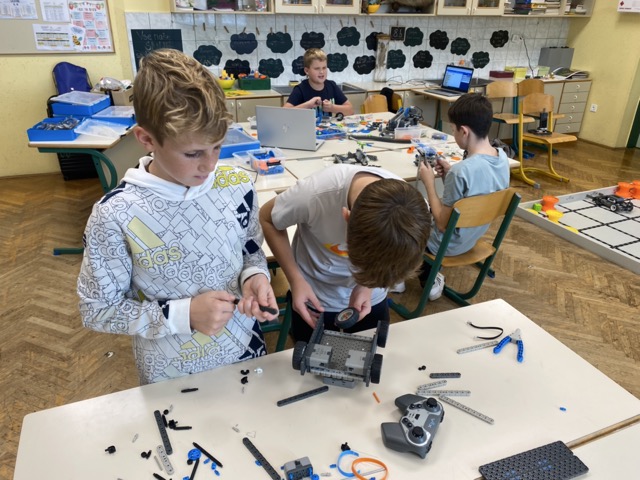
Collaboration in Robotics: VEX Robotics requires students to work in teams to design, build, and code their robots. This collaboration is essential, as STEM fields in the real world often rely on interdisciplinary teams to solve complex problems. A student might answer, “I worked with my team to figure out how to improve the robot’s grip.” From there, educators can emphasize how teamwork leads to success in both school and real-life STEM careers.
Developing Interpersonal Skills through STEM: Group projects in robotics foster essential soft skills, such as communication, leadership, and compromise. Sitting with someone at lunch may seem unrelated to STEM, but the ability to work well with others, share ideas, and collaborate on complex tasks starts with social interaction. Robotics teams learn to listen to each other’s ideas, delegate tasks based on strengths, and handle conflicts constructively—skills they will carry into their future careers.
In fact, robotics competitions like the VEX Robotics Competition provide real-world applications of these teamwork skills. These events bring together students from diverse backgrounds, challenging them to collaborate in high-pressure environments to solve technical problems. The ability to work effectively in a team is not only important for winning competitions but also mirrors how professionals in STEM fields collaborate to innovate and create solutions.
3. “If you could change one thing about today, what would that be?”
This question invites students to think critically about their experiences and encourages a growth mindset. When applied to STEM and robotics, it helps students reflect on areas for improvement—whether in the design of their robot, their problem-solving approach, or how they collaborated with their team.
Engineering and Iteration in Robotics: In VEX Robotics, trial and error are central to the learning process. A student might say, “I wish I had more time to test my code,” or “I think I could have built the arm of the robot differently.” This opens up a conversation about the engineering design process, where iteration and continuous improvement are key. Asking students to reflect on what they would change promotes self-assessment and reinforces the idea that failure is a stepping stone to success.
Emphasizing the Growth Mindset: In STEM, setbacks and challenges are opportunities for growth. By asking what they would change, educators and parents help students see failure as part of the learning process. In robotics, failure often comes in the form of a design that doesn’t work as expected or a code that doesn’t execute the desired task. However, these experiences teach students the importance of resilience, patience, and persistence—qualities that are essential in any STEM career.
Application Beyond the Classroom: This reflective approach is particularly relevant in today’s fast-paced, technology-driven world, where the ability to adapt, innovate, and improve is highly valued. In VEX Robotics, students can directly apply these lessons as they refine their designs and codes for better performance in competitions, fostering a mindset of continuous learning and adaptation that will serve them well in their future STEM endeavors.
4. “What was the hardest rule to follow today?”
This question targets self-regulation and critical thinking about boundaries, which in the context of STEM and VEX Robotics could relate to understanding project constraints, competition rules, or even the laws of physics that govern how their robot can operate.
Learning through Constraints: Robotics projects are often constrained by certain rules—whether it’s the size of the robot, the materials they can use, or the coding languages available. A student might say, “It was hard to keep our robot within the size limit,” or “The hardest part was making sure the robot didn’t go too fast and lose control.” These answers provide a starting point to discuss the importance of constraints in engineering and design.
Problem-Solving Within Limits: VEX Robotics competitions require students to adhere to specific rules and constraints, which mirrors the reality of STEM fields, where engineers and scientists often have to work within defined parameters. Learning to innovate within these boundaries is a valuable skill. Educators can use these discussions to highlight the creative problem-solving involved in working within constraints, whether it’s designing a robot to complete a specific task or coding within the limits of a particular programming environment.
Critical Thinking in STEM: In addition to physical and technical constraints, students also face ethical and safety considerations in robotics. Understanding and following these rules helps students develop critical thinking skills that extend beyond robotics, preparing them for careers in STEM fields where ethics and safety are paramount.
5. “Tell me something you know today that you didn’t know yesterday.”
This is perhaps the most direct question for stimulating reflection on learning and growth. In the context of VEX Robotics and STEM education, it encourages students to recognize and articulate their learning, whether it’s a new coding concept, an engineering principle, or a team strategy.
The Power of Reflection: In STEM, knowledge is constantly evolving, and students are always learning something new. A student might answer, “Today I learned how to program a sensor to detect obstacles,” or “I didn’t know that changing the gear ratio would make the robot move faster.” This type of reflection helps solidify their learning and encourages curiosity for further exploration.
Encouraging Lifelong Learning: The field of STEM is built on continuous learning and discovery. By asking students to share something new they learned, educators and parents reinforce the idea that learning is a lifelong process. Whether it’s mastering a new skill in VEX Robotics or understanding a new scientific principle, this question helps students internalize the joy of learning and discovery that is at the heart of STEM education.
Connecting Classroom Learning to Real-World Applications: In robotics, the learning is often immediate and practical. When a student learns a new programming command or mechanical trick, they can apply it right away to improve their robot’s performance. This kind of hands-on, experiential learning makes abstract STEM concepts more tangible and meaningful. Encouraging students to reflect on what they’ve learned helps bridge the gap between classroom knowledge and real-world application, making their learning more relevant and engaging.
Conclusion: Building a Foundation for STEM Success
Asking the right questions is essential for guiding children through their educational journeys, especially in STEM fields where inquiry, problem-solving, and innovation are key. The five questions discussed in this blog post—designed to move beyond the mundane “How was school?”—are powerful tools for engaging students in deeper conversations about their learning experiences, particularly in hands-on, collaborative environments like VEX Robotics.
By connecting these questions to STEM learning, we encourage students to reflect on their successes and challenges, collaborate with their peers, think critically about constraints, and recognize their own growth. Through these conversations, we can inspire a lifelong love of learning, curiosity, and problem-solving—qualities that are essential for success in the ever-evolving world of STEM.
In VEX Robotics, these questions not only help students process their learning experiences but also prepare them for real-world STEM careers where teamwork, resilience, creativity, and continuous learning are key. By fostering these skills through thoughtful reflection, we are helping to shape the innovators, engineers, and scientists of tomorrow.